The story
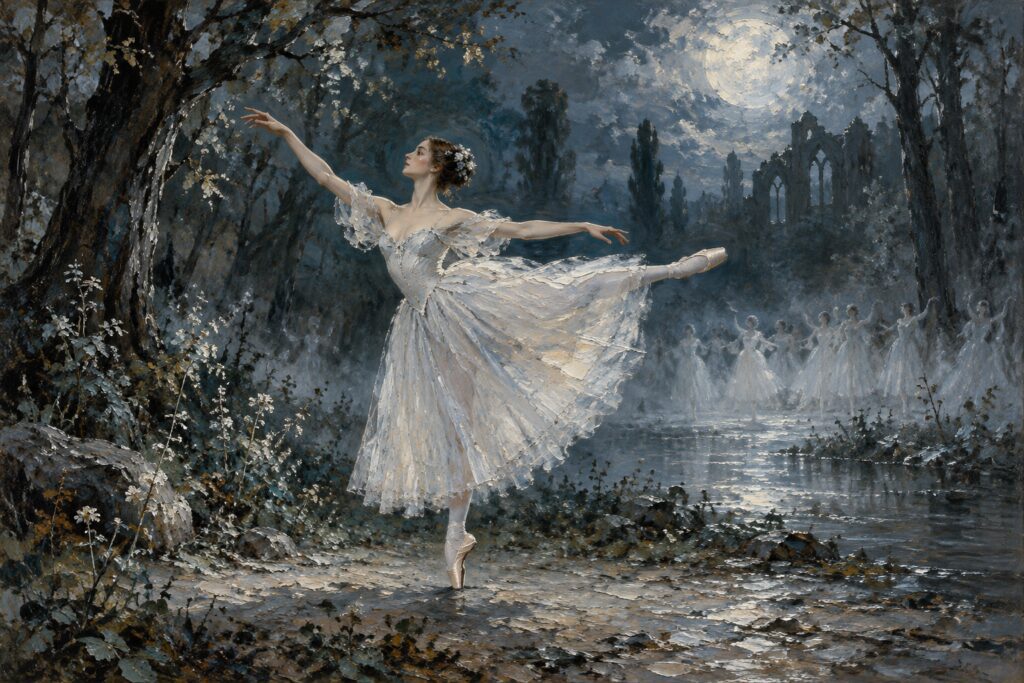
Giselle loves Albrecht without knowing that he is a nobleman already promised to someone else. When his deception is exposed, her world collapses. After her death, the action passes into the domain of the Wilis: spirits of betrayed women who force men to dance to their deaths. Giselle must confront the difference between their desire for revenge and her own attachment to Albrecht.
Origins and choreography
First performed in Paris in 1841, Giselle combines Adolphe Adam’s score with choreography originally credited to Jean Coralli and Jules Perrot. Later stagings by Marius Petipa helped transmit the ballet. The title therefore describes a continuing performance tradition, rather than one unaltered text.
LookBallet viewing guide
Compare the heroine’s movement before and after the change of world. Does a familiar gesture seem different when it becomes slower, lighter or more distant? Watch the ensemble’s response to Myrtha, and ask how the group makes an individual dancer appear vulnerable. You do not need to name the steps to follow these relationships.
Compare two interpretations
- Classical staging: Paris Opera Ballet’s Giselle, adapted by Patrice Bart and Eugène Polyakov from the Coralli–Perrot choreography, with Adolphe Adam’s score.
- Contemporary reinterpretation: Akram Khan’s Giselle for English National Ballet, set in a world of displaced workers, with a reworked score by Vincenzo Lamagna.
For the traditional narrative and choreographic vocabulary, explore the Paris staging. For a contemporary response to the story, explore Khan’s version. Each production page links to its official viewing platform, where access depends on the current catalogue and your location.
Want to explore more viewing services? See our guide to official ballet and dance streaming platforms, including rentals, subscriptions and free archives.
Choosing a version
Start with a production’s choreographic credits. A contemporary reimagining and a classical staging can share the title while offering very different movement, settings and musical treatments. LookBallet already links separate Paris Opera Ballet and Akram Khan production records; choose the recording before checking access terms.
Sources and further reading
Sources reviewed: 15 October 2026. Viewing suggestions are LookBallet editorial guidance.
Two ways into Giselle
La Scala’s classical version follows Coralli and Perrot in Yvette Chauviré’s revival, with Adolphe Adam’s score. Akram Khan’s production for English National Ballet places the story among displaced garment workers, with a score by Vincenzo Lamagna after Adam. Compare how social divisions and the passage to the world of the dead take shape in each staging. These are two productions of the same work.